Stitches, Scissors, and a Touch of Scandal
Dearest Gentle Readers,
This author promised you a revelation. And Lady Whistledown does not deal in empty promises.
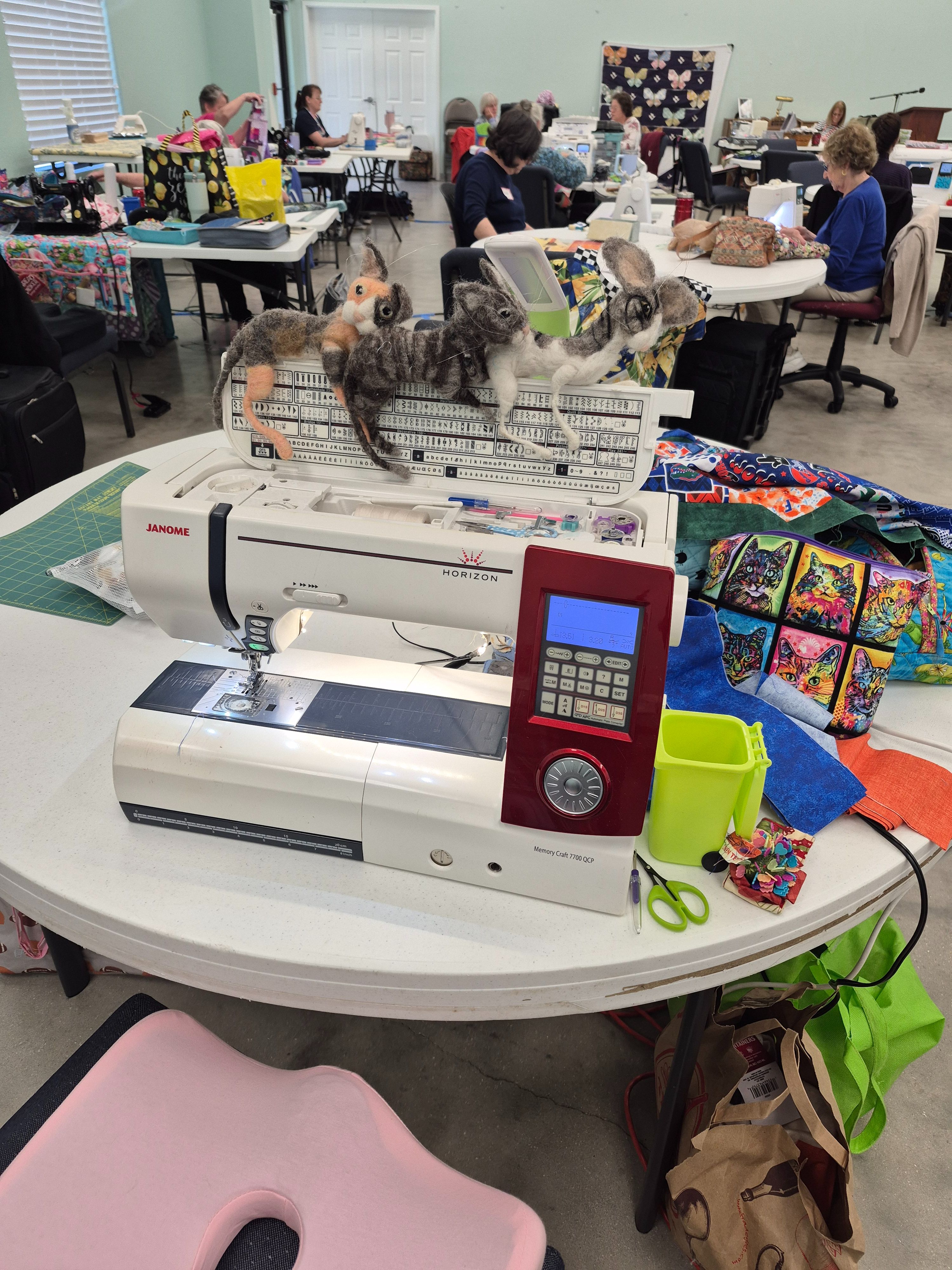
There are, in this world, sewing machines, and then there are sewing machines. The Janome Horizon Memory Craft 7700 QCP, stationed at one of the round tables near the center of the hall, belongs emphatically to the latter category. With its dramatic red panel, its glowing blue screen, its row of buttons arranged with the self-assurance of a command deck, it is less an appliance and more a declaration of intent. It hums not — it announces.
But this author confesses: it was not the machine itself that stopped the room.
It was what sat upon it.
Three needle-felted creatures, cats of impeccable craftsmanship, in shades of grey, brown, and cream, had taken up residence atop the Janome as though they had always lived there and fully intended to continue doing so. One perched at the far edge with the proprietary air of a duchess at her drawing room window. Another leaned against the needle-plate reference card. A third appeared to be supervising operations entirely.
Gentle readers, when one witnesses such a scene, one understands immediately that the owner of this machine is a person of bottomless creativity, great humor, and possibly a talent that deserves its own dedicated dispatch.
Beside the machine: green scissors, riotous-colored fabrics, a bag featuring the most enthusiastic cat artwork one has encountered outside a gallery. The orange extension cord ran dutifully beneath. The cats observed all of it without comment.
One does not come to a retreat merely to sew.
One comes to sew and to be sustained.
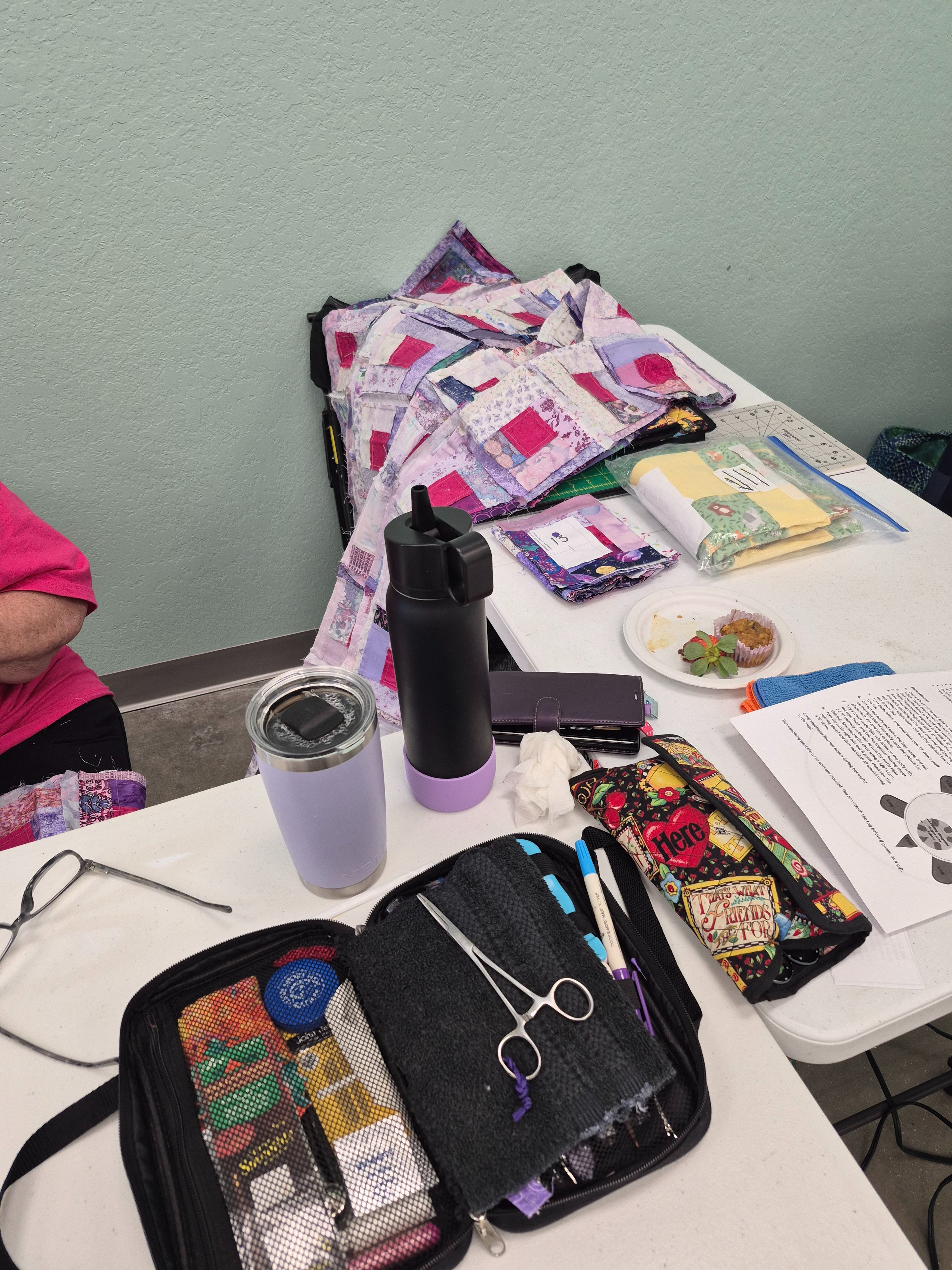
And so it was at one particularly well-appointed station, where a table told the story of a member entirely prepared for every contingency. There was the sewing kit —opened with the purposeful authority of a surgeon's tray, its clamps, scissors, and purple marking tools laid out with professional precision. There was the lavender water tumbler, the black travel mug, standing sentinel against the afternoon's thirst. There was the pattern, neatly folded, and instructions at hand.
And there was, most relevantly, a plate bearing a muffin.
A muffin, dear readers.
With a small green decoration. At ten in the morning.
This author considers this not merely acceptable but actively admirable.
The quilt blocks stacked nearby — purple, pink, floral, with bold red accents in a log cabin variation — suggested a project of great beauty in the making. One could see the blocks were being pieced in that particular shade of lavender that feels like a considered aesthetic choice rather than a happy accident. Beside them, a kit in a sealed bag, a new project waiting its turn with extraordinary patience.
And the pouch. The pouch bearing the words This is What Friends Are For. Lady Whistledown has rarely encountered a retreat accessory that so perfectly captures the spirit of the entire occasion.
At midday, the room transformed.
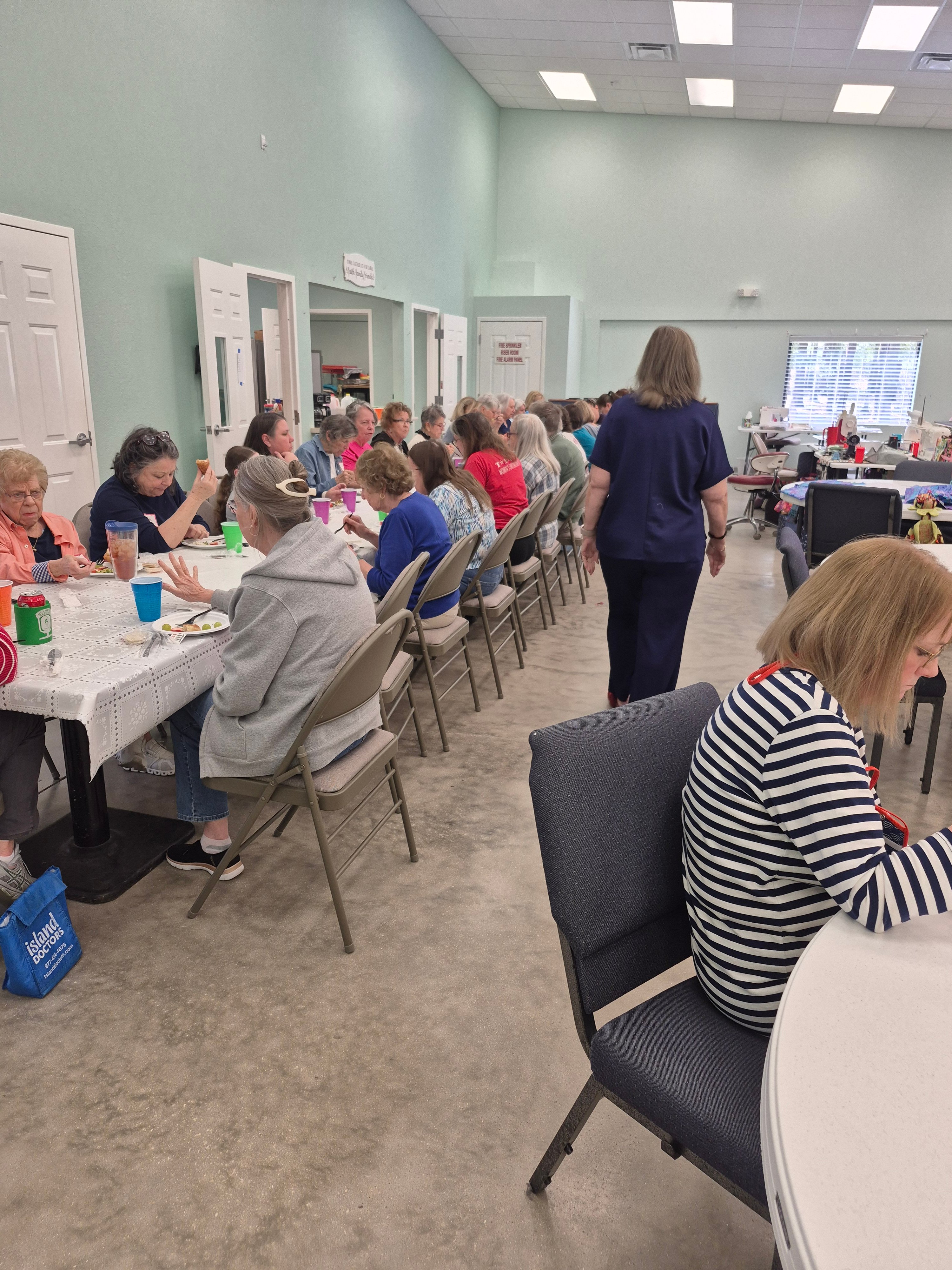
The long tables previously reserved for cutting and laying out were reclaimed for their other sacred purpose: the communal meal. And the guild, being a guild of considerable organization and superior catering instincts, had done itself proud.
Every seat was filled. Conversations overlapped and wove together in the manner of a particularly cheerful quilt top — no two voices the same pattern, yet the whole entirely harmonious. Plates were passed. Glasses of pink and purple and green — a festive rainbow of hydration — were clinked. Smiles were freely exchanged.
At the far end of the table, one member was already sneaking glances back toward the sewing room. Her machine was waiting. Her project was at a critical juncture. The muffin had been consumed. She was, in short, ready to return.
Lady Whistledown understands this impulse entirely.
One does not pause willingly when the seam is calling.
Speaking of which — let us turn our attention to a scene of particular industriousness.
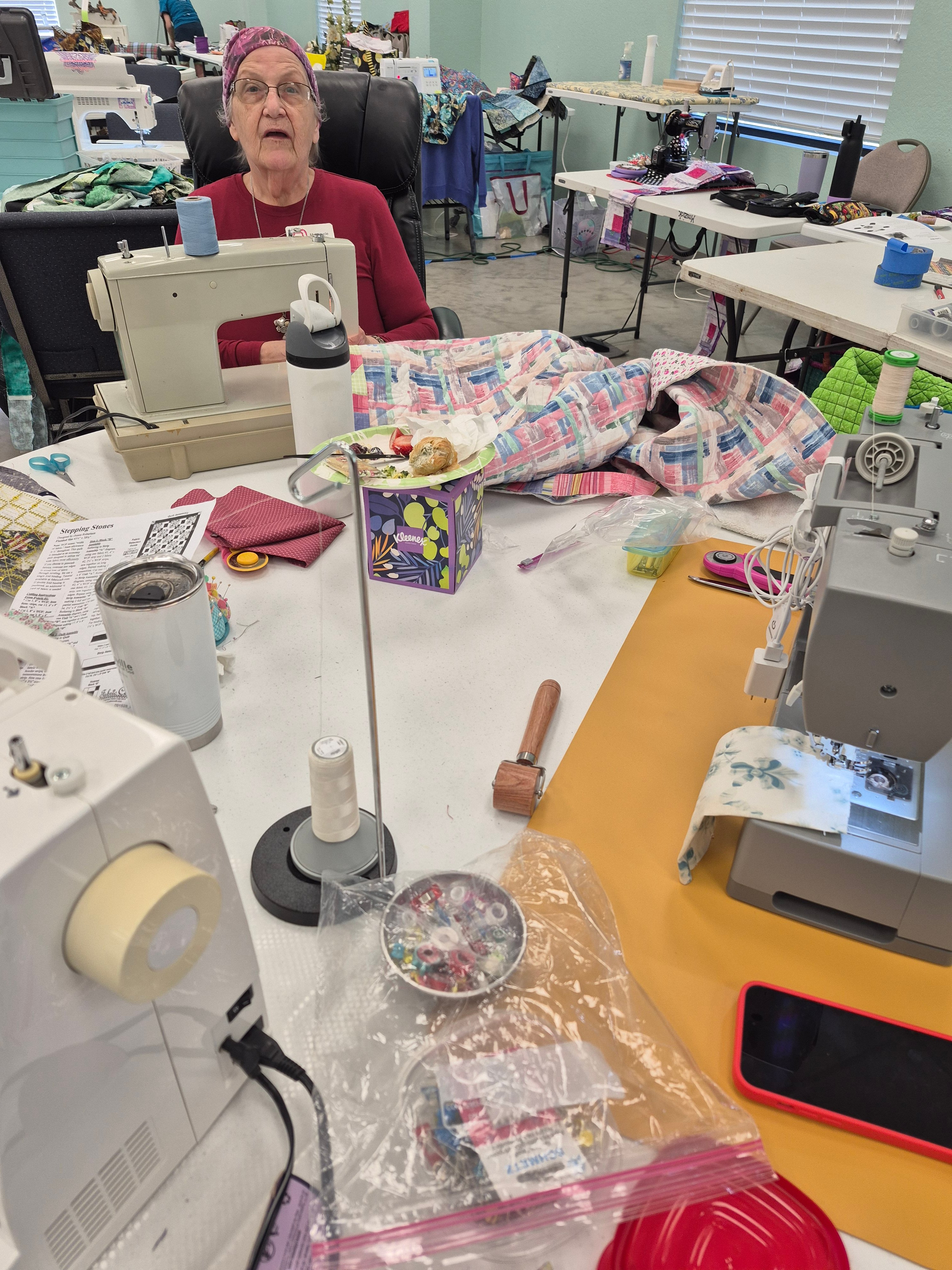
Seated at what might generously be described as an efficiently maximized workspace, one member had arranged her corner of the world with a logic that was entirely her own. Two sewing machines — yes, two — occupied her table with neighborly ease. A pattern was propped for reference, its graphic black-and-white diagram suggesting ambitions of considerable geometric sophistication. A quilt top in blues, pinks, and plaids cascaded across the surface like a small, soft waterfall.
Beside her machine: a Kleenex box (prudent), a wooden mallet (intriguing), and what appeared to be an entire colony of pins and notions compressed into a clear plastic bag of heroic proportions.
The wooden mallet, it must be noted, is not standard equipment in a sewing room. This author made discreet inquiries. It is, apparently, used for certain pressing and clapping techniques that encourage seams to lie flat. Lady Whistledown accepts this explanation fully and will ask no further questions.
The member herself sewed with the serene, unhurried efficiency of a woman who has made her peace with every seam she has ever met, and plans to make peace with every seam she has yet to encounter.
It was, in a word, magnificent.
And yet, dearest readers — the afternoon held still more.
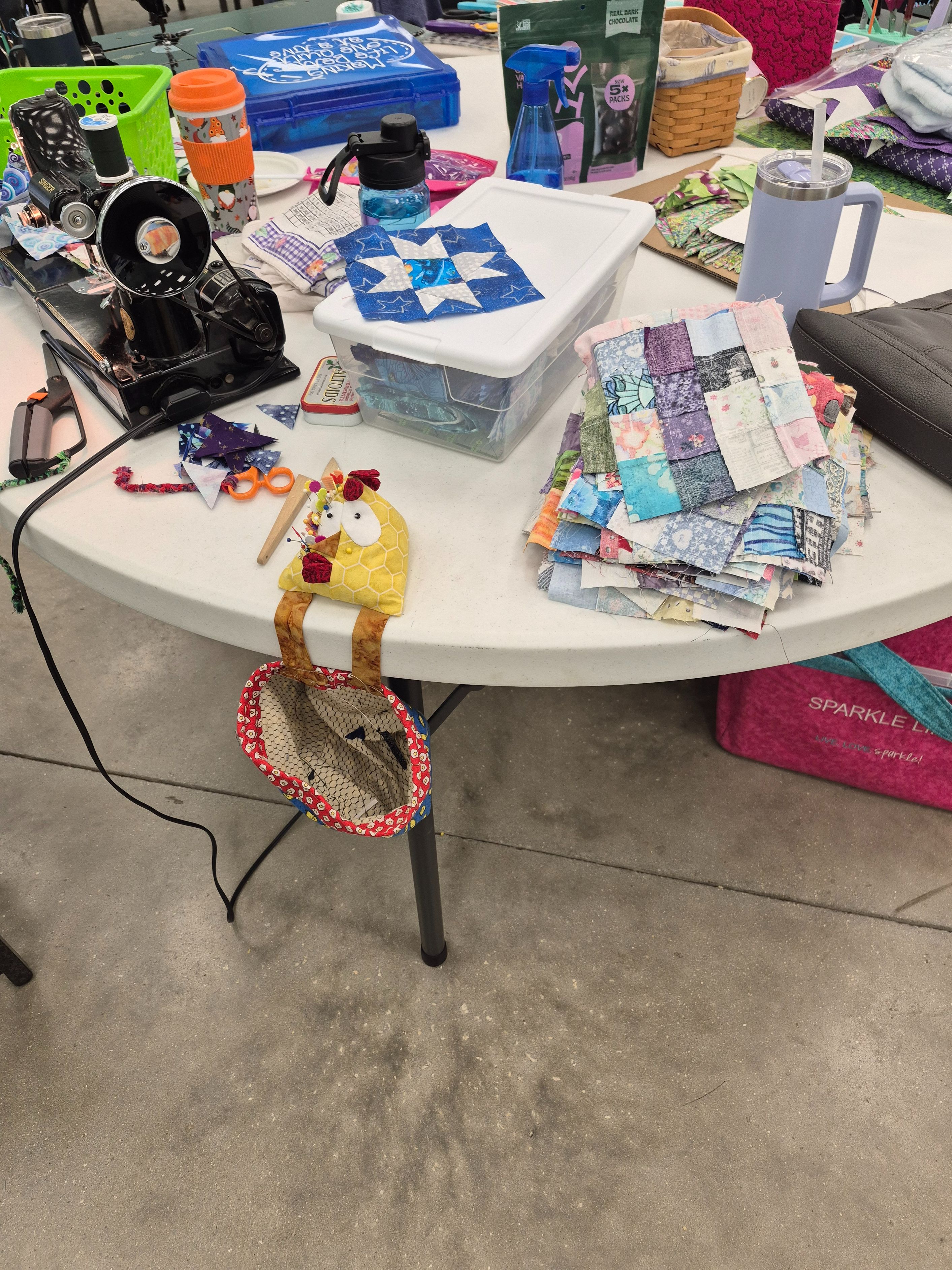
For at the table nearest the corner, a discovery was made that this author is not entirely certain how to classify: a sewn pile of such magnitude and character that it seemed less like a work in progress and more like an ecosystem unto itself. And beside it — a fabric chicken.
Yes. A chicken. Made of fabric. With googly eyes.
More on this, and considerably more besides, in our next installment.
Lady Whistledown has only just begun.
Yours in breathless anticipation,
Lady Whistledown